
Landing Page vs Website: 7 Key Differences for Lead Generation
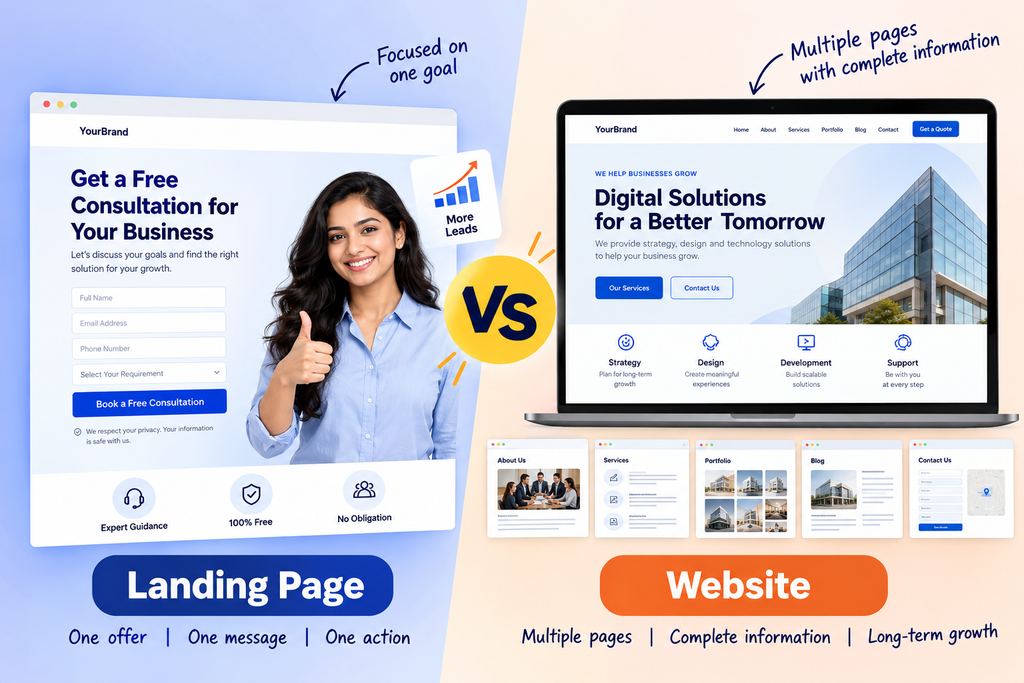
Are you confused about landing page vs website and which one is better for generating leads? Choosing the right option can help your business create a better customer experience, improve advertising relevance and make it easier for potential customers to enquire about your services.
A website helps visitors explore your business, understand your services, read your content and build confidence in your brand. A landing page focuses on a specific offer, campaign or action, such as requesting a quote, booking a consultation or registering for a course.
However, neither option automatically generates more leads. The results depend on your audience, marketing strategy, offer, page experience and follow-up process.
In this guide, we will explain the difference between a landing page and a website, compare their advantages, explore when to use each option and share practical ways to improve lead generation.
What Is a Website?
A business website is a collection of connected web pages that provides information about a company, its services, products and contact details. It acts as the online home of a business and allows visitors to explore different aspects of the brand.
A typical business website includes several important pages.
- Homepage: Introduces the business and its main offerings.
- About Us: Explains the company’s background, experience and values.
- Services or Products: Describes what the business offers.
- Portfolio or Case Studies: Shows relevant work, projects or results.
- Blog: Provides educational content that answers customer questions.
- Contact Us: Helps visitors get in touch with the business.
- Privacy Policy: Explains how personal information is handled.
The exact structure depends on the business model and customer needs.
Advantages of a business website
1. Builds brand credibility
Potential customers often want to understand who they are dealing with before making a purchase or requesting a service. A well-organized website can provide company details, genuine reviews, project examples and clear contact information.
2. Supports organic search visibility
A website can contain dedicated pages for different services, products and customer questions. This gives the business opportunities to provide useful information for different search intents.
However, having a website does not automatically guarantee Google rankings. Content quality, technical accessibility, relevance and competition also matter.
3. Supports multiple services
Businesses offering several services can explain each one separately. Visitors can explore the services that match their requirements rather than relying on a single general page.
4. Helps customers research before contacting you
Some customers are ready to enquire immediately, while others need time to compare options. A website can provide the information needed at different stages of the decision-making process.
5. Supports long-term content marketing
Publishing helpful articles, guides and frequently asked questions can answer common customer problems and create additional opportunities for relevant search traffic.
Limitations of a website for lead generation
A website can generate enquiries through its homepage, service pages and contact forms. However, a general homepage may not be the best destination for every advertising campaign.
For example, a visitor clicking an advertisement for a specific SEO service may have to navigate through several sections to find the relevant details.
A homepage also needs to communicate the overall business, which can make its messaging less specific to an individual campaign.
The solution is not necessarily to remove the website. Instead, choose the most relevant page for each visitor.
What Is a Landing Page?
A landing page is a web page designed around a particular audience, marketing campaign, offer or primary action.
For example, a coaching institute promoting a free counselling session could create a landing page explaining the session, who can attend, what students can expect and how parents can register.
Unlike a general homepage, a landing page focuses on a specific purpose.
Common examples include:
- Requesting a service quotation
- Booking a consultation
- Registering for a course
- Scheduling a product demonstration
- Downloading a useful resource
- Enquiring about a specific service
- Registering for an event
A landing page can exist within the main business website. It does not necessarily require a separate domain.
Advantages of a landing page
1. Focuses on one primary action
A landing page can guide visitors towards a clear next step, such as booking an appointment or submitting an enquiry.
2. Supports campaign-specific messaging
The page can match the offer, audience and message used in an advertisement. Visitors can immediately understand whether the page is relevant to what they clicked.
3. Makes campaign measurement easier
A focused page can help marketers measure completed forms, bookings and other meaningful actions associated with a campaign.
4. Supports conversion testing
Businesses can test different headlines, CTA wording, form layouts and content arrangements to understand which versions work better with their audience.
Limitations of a landing page
A landing page may not provide enough information for customers who want to compare several services or learn more about a company.
A single page can also be insufficient for businesses that need a detailed product catalogue, extensive service information or a comprehensive portfolio.
Additionally, a landing page does not automatically produce better conversion rates or rank well in search results. Its effectiveness depends on its usefulness, relevance, usability and the quality of the traffic it receives.
Landing Page vs Website: 7 Key Differences
Understanding the main differences can help you decide which option suits your business goals.
| Comparison | Landing Page | Website |
|---|---|---|
| Primary purpose | Promote a specific offer or action | Present broader business information |
| Structure | Usually one focused page | Multiple connected pages |
| Content | Campaign-specific | Covers several services, products or topics |
| Navigation | Often simplified | Usually includes site-wide navigation |
| Lead generation | Focuses on one primary conversion goal | Can generate leads through several pages |
| SEO opportunities | Can target relevant, specific searches | Can address a wider range of search intents |
| Common applications | Ads, registrations and consultations | Brand discovery, research and long-term content |
These differences describe common patterns rather than strict rules. A detailed service page on a website can also work as a landing page when it is the most relevant destination for a campaign.
Which Is Better for Lead Generation?
The answer to the landing page vs website question depends on the visitor’s intent, traffic source and the information required before taking action.
1. Landing pages for focused advertising campaigns
A dedicated landing page can be useful when an advertisement promotes one specific service, product or offer.
Imagine a business running an advertisement for website development. Instead of sending every visitor to a general homepage, the business could direct them to a page explaining its website development service, process, deliverables and enquiry options.
The visitor does not have to search through unrelated sections to understand the offer.
For this approach to work, the page must match the advertisement and provide enough information to support an informed decision. A landing page alone cannot compensate for irrelevant targeting, an unclear offer or poor follow-up.
2. Websites for broader customer research
A website can be more useful when visitors need to understand several services, compare options or verify the business before enquiring.
For example, someone researching an interior design company might want to explore its portfolio, understand its process, review genuine customer feedback and learn about different project types.
A website can bring this information together in a structured way.
It can also support organic search visibility by providing useful pages for different customer questions.
3. Both options for complex buying decisions
Businesses selling higher-value services may benefit from using both a full website and focused landing pages.
A visitor might initially arrive through an advertisement, review a campaign page and then explore the main website before making a decision.
This is particularly relevant for services where customers need detailed information, examples of previous work or confidence in the provider.
The best destination is the one that meets the visitor’s expectations and makes the next step clear.
When Should You Use a Landing Page?
A landing page is worth considering when you have a specific marketing objective.
Google Ads campaigns
When advertising a particular service, send visitors to a relevant destination that explains the service and provides a suitable next step.
For example, someone searching for a specific business service should ideally reach a page that directly addresses that requirement, rather than a homepage containing several unrelated offers.
Meta Ads campaigns
Businesses advertising on Facebook or Instagram can use landing pages to explain a promotion, consultation, course or product in more detail.
The page should continue the message of the advertisement and make it easy for interested visitors to enquire.
Course registrations and counselling
Coaching institutes can create separate pages for particular courses, entrance examinations, demo classes or counselling sessions.
This allows students and parents to understand the specific programme before registering.
Local service promotions
A local service provider can create a page explaining one service, the areas it genuinely serves and how customers can request assistance.
The page should provide accurate service information and clear contact options.
Product launches and events
Businesses launching a product, organising an event or promoting a limited campaign can use a focused page to explain the offer and collect registrations.
In each case, the page should contain sufficient information to answer common questions. Making a page shorter is not useful if visitors are left uncertain about what is being offered.
When Does Your Business Need a Full Website?
A multi-page website is generally useful when a business has several offerings, needs to support different customer journeys or wants to build a long-term online presence.
Consider a full website if your business:
- Offers multiple services or products.
- Needs a portfolio or project gallery.
- Wants to publish educational articles.
- Serves different customer segments.
- Needs detailed company and contact information.
- Wants to support organic search across several topics.
- Needs product categories, payment functionality or customer support pages.
For example, a digital marketing company offering SEO, web development, Google Ads and Meta Ads may need individual service pages to explain each offering clearly.
A single landing page might not provide enough space or structure for all these different services.
A full website also allows visitors to explore the information they need without requiring every visitor to follow the same path.
Can You Use a Landing Page and Website Together?
Yes. For many businesses, combining a website with focused landing pages is a practical way to support different marketing objectives.
The website provides broader business information, while campaign pages focus on specific offers or audiences.
Consider a coaching institute promoting an entrance-exam preparation programme.
Step 1: Attract visitors. The institute uses search, social media or paid advertisements to reach relevant students and parents.
Step 2: Provide relevant information. Visitors who click a course-specific advertisement reach a page explaining that programme, its format and the available enquiry options.
Step 3: Capture enquiries. Interested visitors submit a form, request a call or register for counselling.
Step 4: Support further research. Visitors who need more information can explore the institute’s wider website to understand its other programmes and business details.
Step 5: Follow up. The institute contacts the enquiries, answers questions and tracks which leads progress towards admissions.
This approach gives visitors a focused starting point without removing access to broader information.
The same principle can apply to interior designers, local service providers, professional consultants and other businesses.
9 Landing Page Design Best Practices for More Leads
A landing page should be easy to understand, relevant to its audience and straightforward to use. The following practices can help improve the experience.
1. Write a clear headline
Visitors should quickly understand what the page offers and who it is for.
Avoid vague headlines that could apply to almost any business. Use wording that reflects the actual service, offer or problem being addressed.
2. Match the landing page to the advertisement
If an advertisement promotes a specific consultation, the landing page should explain that consultation.
Keep the offer, service details and primary message consistent. Visitors should not have to guess whether they reached the correct page.
3. Use one clear primary CTA
Choose an action that reflects the visitor’s next step.
Examples include:
- Request a Quote
- Book a Consultation
- Enquire About the Course
- Schedule a Demo
- Register for an Event
You can repeat the same CTA at useful points on a longer page. The aim is to avoid distracting visitors with several unrelated offers.
4. Keep forms practical
Ask only for the information needed to respond to or qualify an enquiry.
A simple service form might request a name, phone number, email address and service requirement. A more complex service may require additional questions about budget or project timelines.
The right form depends on the business and the nature of the enquiry.
Explain what happens after submission and provide access to the relevant privacy information.
5. Add genuine trust signals
Depending on the business, useful trust signals can include:
- Genuine customer reviews
- Relevant project examples
- Accurate business details
- Verifiable qualifications
- A clear explanation of the process
- Relevant product or service information
Avoid fabricated testimonials, misleading urgency and unsupported guarantees.
6. Make the page mobile-friendly
Visitors should be able to read the content, tap buttons and complete forms easily on a smartphone.
Check the page on actual mobile devices. Pay attention to text size, form fields, button spacing, image loading and layout stability.
Google’s Core Web Vitals provide useful performance thresholds:
- Largest Contentful Paint (LCP): 2.5 seconds or less.
- Interaction to Next Paint (INP): 200 milliseconds or less.
- Cumulative Layout Shift (CLS): 0.1 or less.
These measures help assess loading, responsiveness and visual stability. Meeting the thresholds does not guarantee a specific conversion rate.
7. Make the next step clear
Visitors should know what will happen after they submit a form or request contact.
For example, explain whether the business will call them, send further details or arrange a consultation.
Only promise response times or services that the business can genuinely provide.
8. Test the complete enquiry process
Submit test enquiries before launching a campaign.
Confirm that forms work, confirmation messages appear, notifications reach the correct person and contact options function properly.
If conversion tracking is installed, verify that successful submissions are recorded correctly.
9. Test changes using meaningful results
Businesses can experiment with headlines, CTA wording, form length and page layout.
Before testing, decide which outcome matters. A change that produces more button clicks may not necessarily produce more qualified enquiries or sales.
Compare results carefully and avoid making conclusions from very small amounts of data.
How to Measure Lead Generation Performance
The number of visitors or clicks alone does not tell you whether a page is helping the business grow.
Track actions that matter to your customer acquisition process.
| Metric | What it measures |
|---|---|
| Landing page visits | Number of visits to the page |
| Completed form submissions | Enquiries successfully submitted |
| Cost per lead | Advertising cost per recorded lead |
| Qualified leads | Leads that meet your business criteria |
| Lead-to-customer rate | Share of leads that become customers |
| Customer acquisition cost | Cost of acquiring a customer |
| Return on ad spend | Revenue attributed to advertising relative to ad spend, when measured appropriately |
For example, a page may generate many enquiries but still deliver poor business results if most leads are irrelevant or never become customers.
A business should distinguish between a button click, a completed enquiry, a qualified lead and an actual sale.
Set up tracking around successful actions rather than relying only on button clicks. Where practical, connect campaign data with a CRM or structured lead record so that enquiries can be followed from initial contact to their final outcome.
Common Mistakes That Reduce Lead Generation
Even a well-designed page can perform poorly if it does not meet visitor expectations.
Sending every advertising visitor to the homepage
A general homepage may not explain the specific service or offer mentioned in an advertisement. Choose a destination that directly addresses the visitor’s needs.
Using unclear messaging
Visitors should understand what the business offers, who the service is for and what action to take next.
Asking for unnecessary information
Forms that request too much information can create friction. Keep the initial enquiry process proportionate to the service and the information required.
Removing all navigation and supporting information
A focused page does not need to provide every website link, but it should remain useful and trustworthy. Some visitors need contact details, privacy information or supporting evidence before enquiring.
Ignoring mobile usability
Difficult forms, small buttons, slow-loading images and layout problems can make a page frustrating to use.
Failing to track completed enquiries
Button clicks do not confirm that a form was submitted successfully. Check that the intended conversion event is recorded correctly.
Focusing only on cheap leads
A low cost per lead does not automatically mean a campaign is profitable. Evaluate the quality of enquiries and the number of customers generated.
Creating duplicate pages without a useful purpose
Each page should serve a genuine audience need. Creating near-identical pages with minimal differences simply to target keyword variations is not a sound content strategy.
Landing Page vs Website: Examples for Different Businesses
Local service business
A local service provider can maintain a website containing service details, business information and contact options. A focused landing page can explain a particular service and make it easy for interested customers to request assistance.
Coaching institute
The website can explain the institute’s programmes, faculty and admissions process. Separate landing pages can support specific courses, demo classes or counselling campaigns.
Interior design company
The website can showcase the portfolio, project process and different services. A campaign landing page can focus on a particular consultation or project type.
E-commerce brand
An online store needs product information, categories, checkout, delivery details and customer support. A focused campaign page may be useful for promoting a particular collection or product, but it should not replace essential shopping functionality.
B2B service company
A B2B business may need a website containing service information, company details, case studies and resources. A dedicated landing page can support a specific demo or consultation campaign while allowing potential customers to research the company further.
These examples illustrate common approaches rather than guaranteed outcomes. The best structure depends on the business model, offer, audience and customer journey.
Frequently Asked Questions
1. Is a landing page the same as a website?
No. A website is a collection of connected pages that provides broader business information. A landing page focuses on a particular offer, campaign or action. A landing page can be part of the same website.
2. Is a landing page better than a website for lead generation?
A landing page can be useful for a focused campaign, while a website supports broader customer research and multiple services. Many businesses can benefit from using both.
3. Can a landing page rank on Google?
Yes. A landing page can appear in organic search if it is accessible, useful and relevant to a search query. Its performance depends on content quality, relevance, technical accessibility and competition.
4. Should Google Ads traffic go to a homepage or landing page?
Send visitors to the most relevant destination for the advertisement and their intent. This could be a dedicated landing page or a detailed service page on the main website. The homepage is not automatically the best choice.
5. Does a landing page need a navigation menu?
Not necessarily a full website menu. However, contact details, privacy information and supporting evidence should remain accessible where needed. The page should help visitors make an informed decision.
6. What should a lead-generation landing page include?
A lead-generation landing page commonly includes a clear headline, relevant offer, useful explanation, genuine proof, a primary CTA, a usable form or contact option and appropriate privacy information.
7. What is a good landing page conversion rate?
There is no universal conversion rate that every business should expect. Results depend on the industry, offer, traffic source, audience and definition of a conversion.
Use external benchmarks cautiously and compare your own results over time. Qualified enquiries and actual sales are often more useful business measures than raw form submissions alone.
8. Can a small business start with only a landing page?
A focused landing page can be a practical starting point for a single offer or campaign. However, the business should still provide the necessary contact, privacy and trust information. A broader website may become more useful as the business grows or offers more services.
9. How can I improve landing page conversions?
Start by making the offer clear, matching the page to the advertisement, simplifying the enquiry process, improving mobile usability and checking that forms work correctly. Measure completed and qualified enquiries before deciding which changes to make.
Conclusion
The decision between a landing page and a website depends on your business goals and what visitors need before taking action.
A landing page focuses on a particular offer or campaign and provides a clear next step. A website supports broader customer research, multiple services, useful content and long-term online visibility.
For many businesses, using both is a practical approach. Maintain a useful website and create focused campaign pages when a particular audience or offer requires a more specific experience.
Most importantly, measure more than clicks and enquiries. Understand whether the right visitors are contacting your business and whether those enquiries turn into customers.
A successful lead-generation strategy connects the right audience with relevant information, a straightforward next step and a reliable follow-up process.