Google Ads vs Meta Ads: Which Is Better for Your Business in 2026?
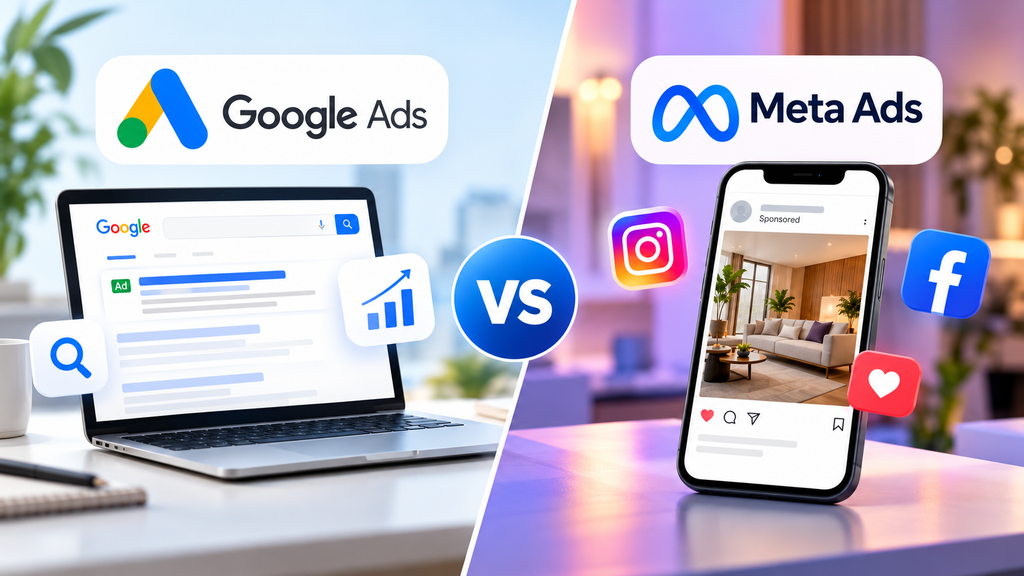
Choosing between Google Ads vs Meta Ads is an important decision for businesses that want to generate leads, increase sales, and grow online. Both platforms can help you reach potential customers, but they work differently and serve different purposes.
Google Ads Search campaigns help businesses reach people searching for relevant products or services. Meta Ads, which appear across platforms such as Facebook and Instagram, help businesses introduce offers, build interest, and reach relevant audiences through visual content.
The right choice depends on your business model, target audience, advertising budget, customer buying journey, and ability to convert leads into customers.
In this guide, we compare Google Ads vs Meta Ads across targeting, costs, lead generation, measurement, and industry use cases so you can choose a strategy that fits your business.
What Is the Difference Between Google Ads and Meta Ads?
The main difference between Google Ads and Meta Ads is how businesses reach potential customers.
Google Ads Search campaigns primarily capture existing demand. A user searches for a product or service, and a relevant advertisement may appear in the search results.
Meta Ads can create awareness and demand by introducing products or services to people while they browse Facebook, Instagram, and other eligible placements.
For example, someone searching for an interior designer in Hyderabad may already be looking for a service provider. Someone watching an Instagram Reel about home interiors may discover a design studio without having searched for one.
Both approaches can generate enquiries. The most suitable platform depends on how your customers discover, evaluate, and purchase your products or services.
Google Ads vs Meta Ads: Quick Comparison
| Comparison factor | Google Ads | Meta Ads |
|---|---|---|
| Main opportunity | Capture existing search demand | Build awareness and generate interest |
| Audience signals | Search queries, keywords, location, and available audience signals | Demographics, audience signals, engagement, and available targeting options |
| Common formats | Search text ads, Display, Shopping, Video, Performance Max | Image, video, carousel, collection, and other eligible formats |
| Lead generation | Search ads, website forms, calls, eligible lead forms | Instant forms, website forms, messages, and eligible call options |
| Creative requirements | Strong keyword relevance, ad copy, and landing page alignment | Engaging visuals, clear offers, and compelling creative |
| Important metrics | Qualified leads, conversions, cost per acquisition | Qualified leads, conversions, cost per acquisition |
| Potential limitation | Relevant search demand may be limited or competitive | Some users may engage without having immediate buying intent |
These are general differences, not guarantees of performance. Google Ads also supports awareness campaigns, and Meta Ads can generate high-intent enquiries when the offer and audience are suitable.
1. How Google Ads Works for Business Growth
Google Ads is an online advertising platform that supports multiple campaign types, including Search, Display, Shopping, Video, and Performance Max.
For businesses trying to generate enquiries, Search campaigns are particularly relevant when potential customers actively search for their services.
For example, a person searching for “digital marketing services in Hyderabad” may be comparing providers and evaluating their options. A relevant Search advertisement can help a business appear during that decision-making process.
Advantages of Google Ads
Reaches people with relevant search intent: Search queries can provide useful signals about what potential customers need.
Supports location-based campaigns: Businesses can configure campaigns to reach relevant geographic areas.
Offers multiple conversion paths: Depending on campaign type and eligibility, businesses can direct users to websites, enquiry forms, calls, or other supported destinations.
Provides conversion measurement: Advertisers can track actions such as form submissions, purchases, and calls when tracking is correctly configured.
Limitations of Google Ads
- Competitive keywords can be expensive.
- Some industries have limited search volume.
- Irrelevant search terms can waste advertising spend.
- Poor landing pages can reduce conversions.
- Clicks do not necessarily represent qualified leads or paying customers.
When should you consider Google Ads?
Google Ads Search campaigns may be suitable when customers already know what they need and actively search for a solution.
Examples include local services, coaching programmes, professional services, and specialized products with clear search demand.
To improve campaign performance, research keywords carefully, use appropriate negative keywords, align ads with landing pages, and measure qualified enquiries rather than clicks alone.
Businesses can also explore our Google Ads management services for support with campaign structure, targeting, and conversion tracking.
2. How Meta Ads Works for Business Growth
Meta Ads enables businesses to advertise across eligible placements on Facebook, Instagram, and other parts of Meta’s advertising ecosystem.
Rather than relying primarily on a search query, Meta campaigns can reach audiences using available targeting options, campaign objectives, audience signals, and creative assets.
For example, an interior design studio can showcase completed projects through Instagram Reels or carousel advertisements. An education institute can promote a counselling session or student assessment through a lead generation campaign.
Advantages of Meta Ads
Visual storytelling: Images and videos can help explain products, services, offers, and customer benefits.
Audience discovery: Businesses can introduce an offer to relevant audiences who may not be actively searching for it.
Lead generation options: Eligible campaigns can use instant forms, website conversions, or messaging destinations.
Creative testing: Advertisers can test different messages, visuals, and offers to understand what resonates with their audience.
Limitations of Meta Ads
- Some users may engage without being ready to purchase.
- Instant forms can generate incomplete or unsuitable enquiries.
- Creative fatigue may affect campaign performance.
- Results depend on the offer, audience, campaign setup, and follow-up process.
- Poor conversion tracking can make it difficult to identify valuable leads.
When should you consider Meta Ads?
Meta Ads may be suitable when a product or service benefits from visual explanation, audience discovery, promotional offers, or remarketing.
Businesses should use relevant creative assets, communicate their offer clearly, qualify leads appropriately, and measure which enquiries become actual customers.
Explore our Meta advertising services to understand how social advertising can support lead generation and customer acquisition.
3. Google Ads vs Meta Ads: Which Is Better for Lead Generation?
Both platforms can generate leads, but lead quality depends on more than the number of forms submitted.
Google Search campaigns may reach people who are already looking for a solution. Meta campaigns can reach relevant audiences earlier in the buying journey and encourage them to enquire.
Lead generation with Google Ads
To generate relevant leads through Google Ads:
- Select keywords that closely match your service.
- Use negative keywords to filter irrelevant searches.
- Write advertisements that accurately describe your offer.
- Send visitors to relevant landing pages.
- Track calls and form submissions correctly.
- Connect qualified leads and sales outcomes to campaign reporting where possible.
Lead generation with Meta Ads
To improve lead generation through Meta Ads:
- Create advertisements for a clearly defined audience.
- Explain the offer and eligibility requirements.
- Use appropriate qualifying questions in lead forms.
- Test instant forms against website forms where suitable.
- Consider click-to-WhatsApp campaigns when messaging is appropriate.
- Follow up promptly and record lead outcomes.
Why cost per lead is not enough
Suppose two campaigns generate enquiries at different costs. The campaign with the cheaper leads is not necessarily the better campaign if fewer of those leads become customers.
Use these metrics to evaluate performance:
Cost per lead (CPL)
[
\text{CPL}=\frac{\text{Advertising Spend}}{\text{Total Leads}}
]
Qualified lead rate
[
\text{Qualified Lead Rate}=
\frac{\text{Qualified Leads}}{\text{Total Leads}}\times100
]
Customer acquisition cost (CAC)
[
\text{CAC}=\frac{\text{Relevant Acquisition Costs}}{\text{New Customers Acquired}}
]
Return on ad spend (ROAS)
[
\text{ROAS}=\frac{\text{Revenue Attributed to Ads}}{\text{Advertising Spend}}
]
For example, a business may receive many inexpensive enquiries from one platform but fewer qualified prospects. Another platform may generate fewer leads that convert more frequently. The better option depends on the cost and value of acquiring customers.
4. Google Ads vs Meta Ads: Which Is More Affordable?
There is no universal price that applies to every campaign, industry, or location.
Advertising costs depend on competition, audience, offer, campaign objectives, bidding strategy, creative quality, landing page experience, and conversion rates.
Google Ads Search campaigns can have higher costs for competitive keywords. Meta Ads may generate inexpensive clicks or initial enquiries in some situations, but those metrics do not automatically indicate better business results.
Before deciding which platform is cheaper, understand these terms:
- CPC: Cost per click.
- CPM: Cost per thousand ad impressions.
- CPL: Cost per lead.
- CPA: Cost per defined acquisition or conversion action.
- CAC: Cost of acquiring a new customer, including the relevant acquisition expenses.
CPA and CAC are not always interchangeable: CPA may refer to a form submission or another conversion, whereas CAC focuses on acquiring a customer.
Avoid selecting a platform solely because an online article reports a low average CPC or CPL. Benchmarks may use different countries, industries, reporting periods, and definitions.
For businesses in India, the most useful approach is to establish a realistic test budget, track qualified enquiries, and calculate the cost of acquiring actual customers.
5. Which Platform Is Better for Different Industries?
The right platform depends on customer behaviour and the way a business sells its products or services.
Local services
Examples include clinics, home services, salons, and professional service providers.
Google Search Ads may help capture people actively searching for a service in their area. Meta Ads can support awareness, visual storytelling, and remarketing where appropriate.
Education and coaching
Google Search Ads can reach people looking for particular courses, examinations, or coaching programmes. Meta Ads can promote course previews, counselling sessions, assessments, and relevant educational content.
A combination may be useful when the business needs both active search demand and audience discovery.
Interior design
Google Ads can reach people searching for interior designers, renovation services, or project estimates. Meta Ads can showcase portfolios, design ideas, completed projects, and video walkthroughs.
The campaign should attract prospective clients who have relevant requirements and realistic project expectations.
E-commerce
Google Ads offers options such as Shopping and Performance Max for eligible product advertising. Meta Ads can support product discovery, catalogue advertising, and remarketing through eligible campaign setups.
Product margins, stock availability, purchase conversion rates, and repeat purchases all affect profitability.
B2B services
Google Search Ads may be useful when decision-makers search for a specific business solution. Meta Ads may support remarketing, content distribution, or event promotion where the target audience is reachable.
For B2B campaigns, longer sales cycles mean that tracking qualified opportunities and closed deals is especially important.
These are starting points for testing, not fixed rules about which platform will always perform best.
6. Should You Run Google Ads and Meta Ads Together?
Yes, when the business goals, budget, and measurement setup justify using both platforms.
A coordinated approach can help a business reach potential customers at different stages of the buying journey.
A practical full-funnel strategy
Step 1: Build awareness with Meta Ads.
Introduce your products or services through relevant videos, images, or offers.
Step 2: Capture active demand with Google Search Ads.
Reach users searching for your business category, service, or solution.
Step 3: Improve the landing page experience.
Provide clear information, genuine trust signals, and a straightforward way to enquire.
Step 4: Follow up and qualify leads.
Use an appropriate CRM, spreadsheet, email, or consent-compliant WhatsApp workflow to track enquiries and their outcomes.
Step 5: Measure the complete customer journey.
Compare qualified leads, sales opportunities, customers, acquisition costs, and revenue.
Do not assume that every conversion attributed to one platform would disappear without that platform. Customers may interact with several channels before purchasing, and attribution systems can credit conversions differently.
Use consistent definitions and reporting periods when comparing performance.
7. Conversion Tracking: How to Measure Results Correctly
Tracking only clicks or form submissions can hide important differences in lead quality.
Google Ads supports conversion tracking and options for connecting offline sales outcomes to advertising measurement. Meta supports website tracking through tools such as the Meta Pixel and Conversions API, subject to the relevant setup and requirements.
These tools can help businesses measure meaningful actions beyond basic traffic.
What should your business track?
- Website form submissions.
- Phone calls and other relevant contact actions.
- Qualified leads.
- Sales opportunities.
- Completed purchases or signed contracts.
- Customer acquisition cost.
- Revenue and ROAS where reliable revenue data is available.
For example, a lead generation business can record whether an enquiry was contacted, qualified, converted into an opportunity, and eventually closed.
Where supported and appropriately configured, connecting CRM outcomes to advertising platforms can help improve optimization toward valuable outcomes rather than just initial form fills.
Understand attribution differences
Google Ads, Google Analytics, and Meta may report different conversion totals because they can use different attribution settings, reporting rules, and conversion windows.
For fair comparisons:
- Define the conversion you want to measure.
- Verify that tracking is working.
- Use consistent reporting periods and clearly documented definitions.
- Compare platform reports with CRM or sales records where possible.
- Avoid treating platform-reported conversions as perfectly comparable across channels.
For technical implementation, consult the official documentation for Google Ads conversion tracking, Google Ads attribution models, and the Meta Conversions API.
8. Common Advertising Mistakes to Avoid
Choosing based only on cheap leads
A low CPL can be misleading if enquiries are irrelevant or do not convert. Track qualified leads and customer acquisition costs.
Sending every visitor to the homepage
A visitor searching for a specific service should reach a page that addresses that need. Align the advertisement, landing page, and call to action.
Running campaigns without conversion tracking
Without reliable tracking, you may optimize for clicks rather than business outcomes. Verify important conversion events before making major budget decisions.
Ignoring lead follow-up
A relevant enquiry can lose value if nobody responds or records its status. Assign responsibility for follow-up and review lead outcomes regularly.
Assuming the same strategy works everywhere
An education institute, an interior design studio, and an e-commerce brand have different buying journeys. Choose the platform and creative approach based on the audience and offer.
Comparing attribution reports without context
Different measurement settings can lead to different reported results. Establish consistent definitions and compare those results with actual sales data wherever possible.
9. How to Choose the Right Advertising Platform
Before spending your budget, answer these questions:
What is your objective? Decide whether you need leads, sales, calls, bookings, or awareness.
Are customers actively searching for your solution? If yes, consider relevant Google Search campaigns.
Does your offering benefit from visual discovery? If yes, Meta Ads may be worth testing.
Is your website ready to convert visitors? Check mobile usability, page speed, messaging, forms, and trust signals.
Can your team manage enquiries? Ensure that leads can be contacted, qualified, and followed through the sales process.
Can you measure customer acquisition? Track qualified leads, customers, and costs rather than relying only on platform engagement.
Start with the channel most aligned with your objective. Test carefully, learn from the data, and expand when the evidence supports additional investment.
10. Google Ads vs Meta Ads for Businesses in Hyderabad
Businesses in Hyderabad can use either platform depending on their audience, service area, competition, and sales process.
A local service provider may use Google Search Ads to reach people actively searching for a nearby solution. An interior design studio may use Meta Ads to showcase projects and reach potential customers through visual content.
An education business may combine course-related search campaigns with social advertisements promoting counselling or assessments.
The most effective strategy is not necessarily the one with the most clicks or lowest initial lead cost. It is the one that generates relevant enquiries and supports profitable customer acquisition.
If your business needs help planning and managing these channels, you can explore a digital marketing agency in Hyderabad to understand how paid advertising, SEO, landing pages, and conversion measurement can work together.
A suitable strategy should reflect your actual business objectives rather than a fixed budget split or a universal claim that one advertising platform is always better.
Frequently Asked Questions
1. Which is better for small businesses: Google Ads or Meta Ads?
It depends on the business and its customers. Google Search Ads can help capture existing demand, while Meta Ads can help introduce offers and reach relevant audiences through social placements. Choose based on your objective and campaign results.
2. Which platform has a lower cost per lead?
There is no universal answer. Costs vary by industry, location, audience, offer, and campaign setup. Compare qualified lead costs and customer acquisition costs rather than relying on CPC or CPL alone.
3. Can I run Google Ads and Meta Ads together?
Yes. Businesses can use Google Ads to reach active searchers and Meta Ads to build awareness, showcase products, and re-engage eligible audiences. Use both when the budget and performance data justify it.
4. Which platform is better for local businesses in Hyderabad?
Google Search Ads may be useful for customers actively looking for local services. Meta Ads can support awareness and visual storytelling. The right mix depends on search demand, audience behaviour, and business goals.
5. What is the difference between CPC, CPL, CPA, and CAC?
CPC measures cost per click. CPL measures cost per lead. CPA measures cost per defined acquisition or conversion action. CAC measures the cost of acquiring a customer, using the acquisition costs included in your calculation.
6. How do I know which advertising platform is generating better leads?
Track the same meaningful business outcomes where possible. Compare qualified lead rates, sales conversions, customer acquisition costs, and revenue, and review your CRM or sales records alongside advertising reports.
7. Do I need a website to run Meta Ads?
Not always. Eligible Meta campaigns can use instant forms or supported messaging destinations. A website may provide more information and support website conversion tracking when appropriately configured.
8. Should I use Google Ads or SEO?
Google Ads provides paid advertising opportunities, while SEO focuses on organic search visibility. They serve different purposes and can complement each other depending on your business goals, resources, and timeline.
Conclusion
Google Ads vs Meta Ads is not a choice with one universal winner. Google Search campaigns can help businesses capture existing demand, while Meta Ads can help introduce offers, build interest, and reach relevant audiences through social content.
The right decision depends on your business model, audience, advertising budget, landing page experience, lead follow-up, and measurement capabilities.
Start with a clear objective, track qualified leads and customer outcomes, and make decisions based on actual performance data. When both platforms contribute meaningful value, a coordinated strategy can help your business reach customers at different stages of their buying journey.