
How to Generate Quality Leads Through Digital Marketing: 7 Proven Strategies
Generating leads is important for every business, but getting more leads does not always mean getting more customers. Businesses need people who are genuinely interested in their products or services and are more likely to make a purchase.
Understanding how to generate quality leads through digital marketing helps businesses attract the right audience, improve conversions, and use their marketing budget more effectively.
Digital marketing channels such as SEO, Google Ads, Meta Ads, social media marketing, and landing pages can help businesses connect with potential customers. The key is to combine these channels with a clear strategy, effective follow-ups, and proper performance tracking.
In this guide, we will explore seven practical lead generation strategies that businesses can use to attract relevant prospects and turn them into customers.
What Are Quality Leads in Digital Marketing?
Quality leads are potential customers who match your target audience, show genuine interest in your offering, and have a reasonable chance of becoming paying customers.
For example, if you run an interior design business in Hyderabad, a person looking for interior design services for a new apartment may be more valuable than someone browsing design photos for inspiration.
A quality lead generally has these characteristics:
- Relevant requirements: The person needs a product or service you provide.
- Purchase intent: They are actively exploring solutions or planning to buy.
- Suitable budget: Their expected spending is reasonably aligned with your pricing.
- Correct contact details: You can reach them for a follow-up.
- Decision-making potential: They can influence or make the purchase decision.
The goal of digital marketing lead generation is not simply to collect contact details. It is to attract prospects who are more likely to become customers.
7 Strategies to Generate Quality Leads Through Digital Marketing
1. Use SEO to Attract High-Intent Customers
Search engine optimization helps your website appear when potential customers search for products, services, and solutions related to your business.
Unlike interruptive advertising, SEO can connect your business with people who are already looking for what you offer.
For example, searches such as “interior designers in Hyderabad,” “best coaching centre near me,” or “digital marketing services in Hyderabad” can indicate that users are exploring relevant services.
To generate quality leads through SEO:
- Research keywords based on customer needs and search intent.
- Create useful service pages and informative blog posts.
- Optimize page titles, meta descriptions, headings, and website content.
- Improve website speed and mobile usability.
- Add clear contact forms and calls to action.
- Build relevant internal links between blogs and service pages.
Businesses that serve a specific location should also focus on Local SEO to improve their visibility in relevant local searches.
Explore our SEO services to understand how search optimization can support long-term business growth.
2. Run Google Ads for High-Intent Searches
Google Ads can help businesses reach people who are actively searching for specific products or services.
For example, a person searching for “Google Ads agency in Hyderabad” may already be considering professional marketing support. A relevant search campaign can help your business appear for that query.
However, generating quality leads requires more than launching advertisements.
Follow these practices:
- Select keywords that match your services and customer intent.
- Use negative keywords to reduce irrelevant clicks.
- Write clear ad copy that communicates your actual offering.
- Direct users to a relevant landing page.
- Track form submissions, calls, and qualified enquiries.
- Review search terms and remove irrelevant traffic.
Avoid evaluating a campaign only by clicks or total leads. Check whether those leads match your target audience and convert into sales opportunities.
Learn more about our Google Ads services for search-based lead generation.
3. Use Meta Ads to Reach Relevant Audiences
Meta Ads on Facebook and Instagram can help businesses reach potential customers based on available audience signals, interests, and campaign objectives.
These platforms can be useful when people may need your service but are not actively searching for it yet.
For example, an education institute can promote counselling sessions or student assessments, while a business service provider can promote a consultation or enquiry offer.
To improve lead quality:
- Define your ideal customer before launching campaigns.
- Use creatives that communicate the offer clearly.
- Explain who the offer is suitable for.
- Ask relevant qualifying questions in lead forms.
- Test instant forms against suitable website landing pages.
- Track qualified leads and actual sales outcomes.
A low cost per lead is not always a sign of success. If the leads are irrelevant or cannot be contacted, the campaign may not generate meaningful business results.
Our Meta Ads services can support businesses looking to reach relevant audiences through paid social campaigns.
4. Create Landing Pages That Convert Visitors
A landing page is designed to encourage visitors to take a specific action, such as requesting a consultation, booking a demo, registering for a course, or submitting an enquiry.
Even a well-targeted campaign may generate poor results if the landing page is confusing or fails to build trust.
A lead generation landing page should include:
- A clear headline that matches the advertisement.
- A simple explanation of the service or offer.
- Relevant benefits and differentiators.
- Genuine testimonials or supporting evidence, where available.
- A visible call-to-action button.
- A short form requesting necessary information.
- A mobile-friendly layout and fast loading speed.
Keep the message consistent from the advertisement to the landing page. If an ad promises a free consultation, the landing page should clearly explain that consultation and how to request it.
Test different headlines, calls to action, and form lengths to identify what works best for your audience.
5. Publish Helpful Content That Builds Trust
Content marketing helps potential customers understand their problems, compare available solutions, and evaluate your business before contacting you.
Useful content can include blog posts, short videos, educational social media posts, case studies, checklists, and frequently asked questions.
For example, a digital marketing business can publish content about SEO basics, advertising mistakes, lead generation methods, and ways to measure campaign performance.
To use content for lead generation:
- Identify the questions your customers frequently ask.
- Create content that answers those questions clearly.
- Include relevant examples and practical recommendations.
- Add contextual links to related service pages.
- Offer a useful next step, such as a consultation or service enquiry.
Avoid creating content only to insert keywords. The content should solve a genuine problem and help readers make informed decisions.
6. Follow Up and Nurture Leads
Not every prospect is ready to purchase immediately. Some may need additional information, time to compare providers, or approval from another decision-maker.
Lead nurturing keeps your business connected with interested prospects until they are ready to take the next step.
You can improve follow-up by:
- Responding to enquiries promptly.
- Confirming the prospect’s requirements.
- Sharing relevant information about your service.
- Scheduling follow-up calls or messages.
- Using email or WhatsApp communication with appropriate consent.
- Recording enquiry status in a CRM or lead tracking sheet.
Your sales team should also record why leads are not converting. Common reasons may include budget mismatch, incorrect requirements, lack of urgency, or unsuccessful contact attempts.
These insights help you improve both your advertising and your sales process.
7. Track Lead Quality and Conversion Metrics
Performance tracking helps businesses understand which channels generate valuable enquiries instead of focusing only on traffic or lead volume.
Monitor these important metrics:
| Metric | What It Tells You |
|---|---|
| Cost per lead (CPL) | How much you spend to generate a lead |
| Lead qualification rate | What proportion of leads meet your requirements |
| Lead-to-customer conversion rate | How many leads become paying customers |
| Cost per acquisition (CPA) | How much it costs to acquire a customer |
| Return on ad spend (ROAS) | Revenue attributed to advertising compared with ad spend |
| Response time | How quickly your team follows up with enquiries |
For example, Campaign A may generate 100 leads at a lower cost, while Campaign B generates 50 leads that are more relevant and convert more frequently.
The better campaign depends on qualified opportunities, customer acquisition costs, and business revenue—not just the total number of leads.
Set up appropriate conversion tracking and connect marketing performance with your sales outcomes wherever possible.
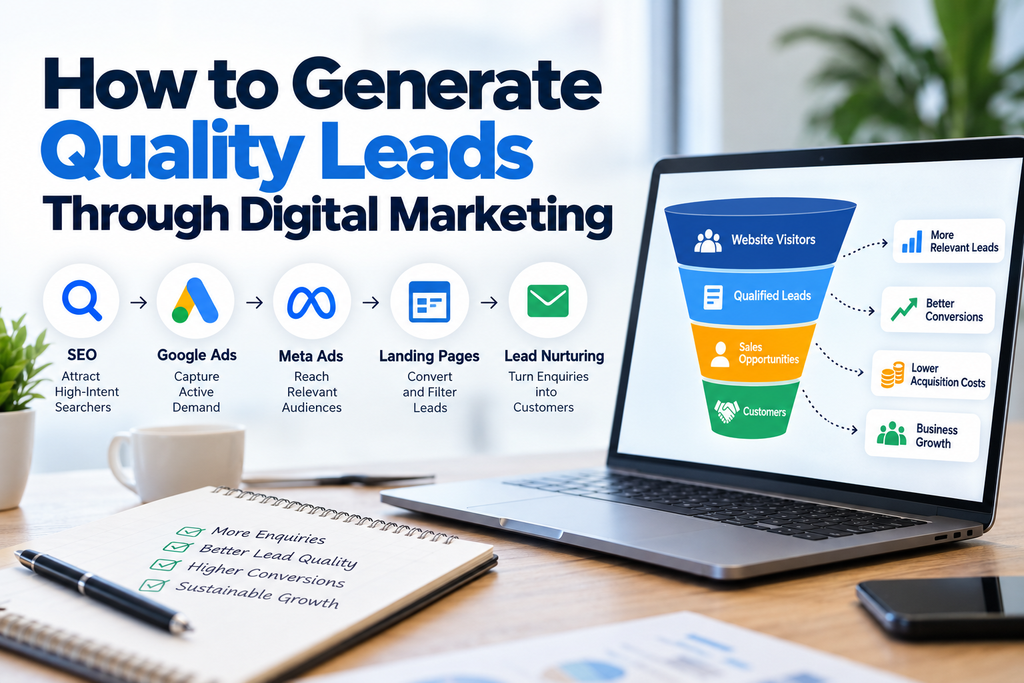
How to Build a Simple Digital Marketing Lead Generation Funnel
A structured funnel helps move potential customers from initial awareness to becoming paying customers.
Step 1: Attract the right audience. Use SEO, Google Ads, Meta Ads, and helpful content to reach relevant prospects.
Step 2: Capture their interest. Direct visitors to a service page, landing page, enquiry form, or consultation offer.
Step 3: Qualify the lead. Ask relevant questions about requirements, location, budget, or timeline where appropriate.
Step 4: Follow up. Contact qualified prospects, answer their questions, and provide the information they need.
Step 5: Measure the outcome. Track which channels and campaigns generate qualified enquiries and customers.
Reviewing each stage helps identify where prospects are dropping off and what needs improvement.
Lead Generation Strategies for Businesses in Hyderabad
Businesses in Hyderabad operate across different industries, including education, healthcare, real estate, professional services, retail, and technology. Each industry requires a different approach to lead generation.
A coaching institute may benefit from search advertising and student counselling offers. A local service provider may focus on Local SEO and Google Business Profile visibility. A B2B company may combine educational content, search campaigns, and targeted follow-ups.
The right strategy depends on your audience, service, competition, budget, and sales process.
Businesses looking for a structured approach can explore a digital marketing agency in Hyderabad to understand how SEO, paid advertising, content, and conversion tracking can work together.
Rather than investing in every channel at once, start with the channels most closely aligned with your customers’ buying intent. Measure lead quality and expand based on actual results.
Common Digital Marketing Lead Generation Mistakes
Avoid these mistakes when planning your lead generation strategy:
- Focusing only on lead volume: More enquiries do not automatically mean more customers.
- Targeting an overly broad audience: Irrelevant traffic can waste advertising budget.
- Using weak landing pages: Confusing messages and lengthy forms can discourage potential customers.
- Ignoring follow-ups: Delayed responses can reduce opportunities to connect with interested prospects.
- Tracking only CPL: Cheap leads may not be commercially valuable.
- Failing to review campaign data: Without tracking, it becomes difficult to identify effective channels.
- Making unsupported claims: Offers and advertisements should accurately represent your services and results.
Improving lead generation usually requires reviewing the complete process—from audience targeting to final sales—not just changing the advertisement.
Frequently Asked Questions
1. How can I generate quality leads through digital marketing?
You can attract quality leads through SEO, Google Ads, Meta Ads, useful content, conversion-focused landing pages, and consistent follow-ups. The best combination depends on your audience and business goals.
2. Which digital marketing channel is best for lead generation?
Google Ads can reach people actively searching for a solution, while Meta Ads can help businesses reach relevant audiences on social platforms. SEO can build long-term organic visibility. Choose based on customer intent, budget, and conversion data.
3. How can I improve lead quality from Meta Ads?
Define your target audience, communicate your offer clearly, add relevant qualifying questions, review lead forms, and track which leads become genuine sales opportunities.
4. Why am I getting leads but not converting them into customers?
Possible reasons include poor audience targeting, unsuitable offers, budget mismatches, slow follow-ups, weak sales processes, or a difference between the advertisement and the actual service.
5. Is SEO useful for lead generation?
Yes. SEO can attract visitors who are searching for relevant information or services. Service pages, local search optimization, useful content, and clear calls to action can help turn that traffic into enquiries.
6. How do I measure the success of a lead generation campaign?
Track cost per lead, lead qualification rate, customer conversion rate, cost per acquisition, and revenue or ROAS where applicable. Compare performance against your business objectives rather than relying on one metric.
Conclusion
Learning how to generate quality leads through digital marketing starts with understanding your customers and creating a clear path from discovery to conversion.
SEO, Google Ads, Meta Ads, content marketing, landing pages, and lead nurturing can each contribute to this process. However, the strongest strategy is one that attracts relevant prospects, follows up consistently, and measures actual business outcomes.
Start with the channels most suitable for your audience, track qualified enquiries, and improve your campaigns using real performance data. With a consistent approach, businesses can build a more reliable lead generation process and support sustainable growth.