
Digital Marketing vs Traditional Marketing: Key Differences Explained
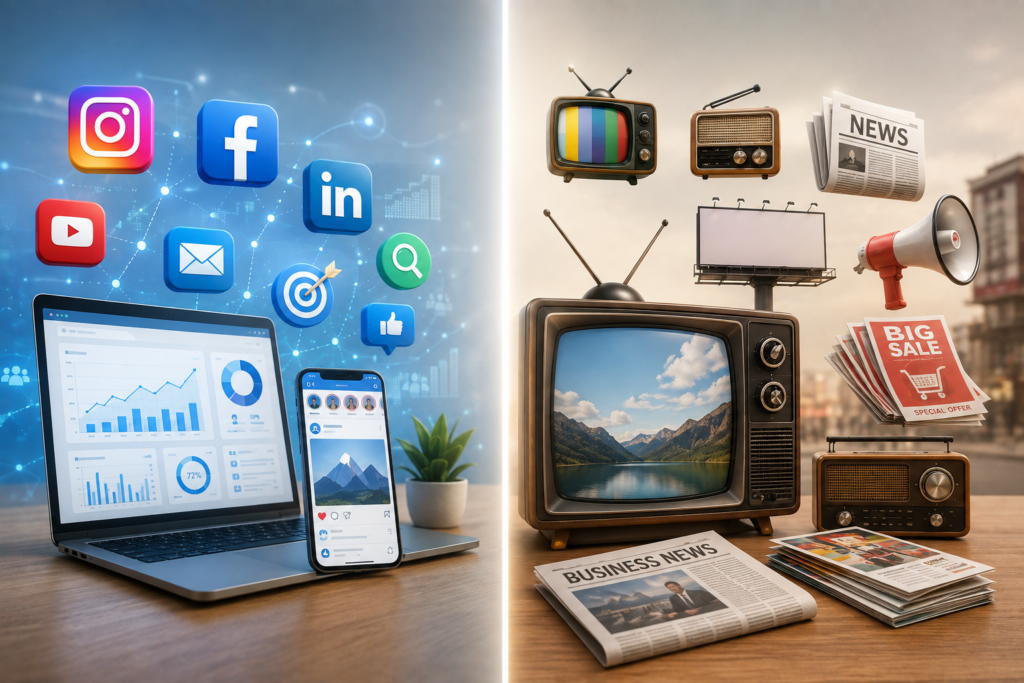
Marketing is essential for every business. It helps brands reach potential customers, create awareness, build trust, and generate sales. But the way businesses market themselves has changed significantly over the years.
Traditional methods such as television, newspapers, radio, flyers, and billboards were once the main ways to reach customers. Today, businesses can also use websites, search engines, social media, email, and online advertising to connect with people.
This leads to an important question: digital marketing vs traditional marketing — which one is better?
There is no single answer for every business. Both methods have advantages and limitations. The right choice depends on your audience, goals, budget, location, and the type of business you operate.
In this guide, we will compare digital marketing vs traditional marketing, explain how each one works, and help you understand when to use one or both.
What Is Digital Marketing?
Digital marketing is the promotion of products, services, or brands through online and digital channels. It allows businesses to reach people through the websites, search engines, social platforms, email services, and other digital channels they use every day.
Some common digital marketing channels include:
- Search Engine Optimization (SEO)
- Pay-Per-Click (PPC) advertising
- Social media marketing
- Content marketing
- Email marketing
- Video marketing
- Influencer marketing
- Affiliate marketing
For example, an interior design company can publish a blog about small home interiors, share completed projects on Instagram, and use Google Ads to reach people searching for interior design services.
One of the biggest advantages of digital marketing is that businesses can track how people interact with their campaigns. This helps marketers understand what is working and where improvements are needed.
What Is Traditional Marketing?
Traditional marketing refers to promotional methods that use offline media rather than internet-based platforms.
Common traditional marketing methods include:
- Television advertisements
- Radio advertisements
- Newspaper advertisements
- Magazine advertisements
- Billboards
- Posters
- Flyers
- Brochures
- Direct mail
- Events and trade shows
For example, a local restaurant may distribute flyers in nearby areas, place an advertisement in a local newspaper, and put up a sign near a busy road.
Traditional marketing can be particularly useful for businesses that depend on local visibility or want to reach people through physical and offline media.
Digital Marketing vs Traditional Marketing: Key Differences
The biggest difference between digital marketing vs traditional marketing is the channel used to reach customers.
Digital marketing takes place through online platforms, while traditional marketing mainly uses offline channels.
| Factor | Digital Marketing | Traditional Marketing |
|---|---|---|
| Channels | Websites, search engines, social media, email, online ads, apps | TV, radio, newspapers, magazines, flyers, billboards |
| Cost | Flexible budgets and scalable campaigns | Often higher upfront production and placement costs |
| Targeting | Can target specific audiences and locations | Usually reaches a broader audience |
| Reach | Local, national, or global | Usually local, regional, or national |
| Communication | Interactive and often two-way | Mostly one-way |
| Measurement | Detailed tracking of clicks, leads, conversions, and sales | Measurement can be more difficult |
| Speed | Campaigns can often be launched and changed quickly | Production and changes can take more time |
| Flexibility | Budgets and content can usually be adjusted quickly | Changes can be difficult after publication |
| Engagement | Comments, messages, shares, reviews, and direct actions | Usually requires a separate action such as a call or store visit |
Understanding these differences makes it easier to choose the right marketing approach.
1. Cost Comparison
Cost is one of the first things businesses consider when comparing digital marketing vs traditional marketing.
Digital marketing can be started with a relatively small budget. Businesses can publish organic content, improve their website for search engines, or test paid advertisements with a controlled budget.
Traditional marketing can involve more upfront expenses. Printing materials, producing television or radio advertisements, renting billboard space, or distributing brochures can require significant investment.
However, digital marketing is not automatically cheap. Competitive advertising campaigns, professional content, video production, and popular keywords can also become expensive.
The important difference is that digital campaigns often give businesses more flexibility to test, adjust, and scale their spending.
2. Audience Targeting
Audience targeting is another major difference between digital marketing and traditional marketing.
Digital platforms allow businesses to reach specific groups based on available information such as location, interests, search terms, demographics, and online behavior.
For example, a wedding photographer in Hyderabad can create an online campaign focused on people interested in wedding-related services in that area.
Traditional advertising generally reaches a broader audience. A newspaper advertisement may be seen by many readers, but the business may not know how many of them are actually interested in its service.
This makes digital targeting especially useful for businesses with a very specific customer group.
3. Reach and Accessibility
Digital marketing can help businesses reach customers in their local area, across a country, or even internationally.
A website can be accessed at any time, while social media pages and online stores can continue attracting visitors outside normal business hours.
Traditional marketing can also achieve wide reach, especially through television, radio, and large publications. However, the reach is often connected to the distribution area of the selected media.
For a local business, this may actually be an advantage. A local flyer, billboard, or newspaper advertisement can focus attention on people living or working nearby.
4. Communication and Customer Engagement
Traditional marketing is generally one-way communication. A company creates an advertisement, and the audience sees or hears it.
Digital marketing creates more opportunities for immediate interaction.
Customers can:
- Comment on social media posts
- Send direct messages
- Ask questions
- Leave reviews
- Share content
- Click links
- Sign up for emails
- Make purchases online
For example, a clothing store can post a new collection on Instagram. Customers can ask about sizes in the comments, send a message, and visit the website to place an order.
This direct communication can help businesses build stronger relationships with customers.
5. Measuring Marketing Results
One of the strongest advantages of digital marketing is measurement.
Businesses can track information such as:
- Website traffic
- Search performance
- Ad impressions
- Clicks
- Click-through rate
- Leads
- Conversions
- Sales
- Social media engagement
- Customer acquisition costs
If an online advertisement gets many clicks but very few sales, the business can investigate the problem and change the campaign.
Traditional marketing results can be harder to measure. Businesses may use customer surveys, special coupon codes, dedicated phone numbers, or feedback forms to understand where customers came from.
These methods can work, but they may not provide the same level of detail available through digital analytics.
6. Speed and Flexibility
Another important difference in digital marketing vs traditional marketing is how quickly campaigns can be changed.
Digital content can usually be updated quickly. A business can change an advertisement, update a website, adjust a budget, or publish a new social media post within a short time.
For example, if a paid campaign is not performing well, a business can pause it and test a different message.
Traditional campaigns often require more preparation. A brochure needs to be designed and printed. A billboard needs to be booked and produced. A newspaper advertisement needs to be submitted before publication.
Once traditional material has been printed or published, making changes can be difficult or expensive.
Which Is Better for Small Businesses?
For many small businesses, digital marketing can be a practical starting point because it offers flexible budgets, audience targeting, and measurable performance.
A small business can begin with:
- A professional website
- Local SEO
- Social media
- Helpful blog content
- Email marketing
- Small paid campaigns
For example, a local salon can create a Google Business Profile, publish Instagram content, collect customer reviews, and run location-based advertisements.
However, traditional marketing should not automatically be ignored.
A local restaurant may benefit from flyers and outdoor signs. A real estate business may use printed property brochures. A community event may use posters and local newspaper advertisements.
The right choice depends on where your customers are and how they make purchasing decisions.
When Is Traditional Marketing Still Useful?
Traditional marketing continues to have value in several situations.
It can be useful when:
- Your customers are concentrated in a specific local area
- Physical visibility matters
- Your audience responds well to television, radio, or print
- You are promoting a local event
- Your business benefits from face-to-face interaction
- Physical materials support the customer experience
For example, a local fitness center could use posters and flyers to create awareness in nearby neighborhoods while using social media and email to follow up with interested customers.
Can Digital Marketing and Traditional Marketing Work Together?
Yes. Businesses do not always have to choose between the two.
Combining digital marketing and traditional marketing can create a stronger overall campaign.
For example, a fitness center could distribute flyers containing a QR code. When people scan the code, they can visit a landing page and register for a free trial.
In this case:
Traditional marketing → creates local awareness
Digital marketing → captures the lead and continues communication
Other combinations include:
- A billboard directing people to a website
- A newspaper advertisement containing a promotional code
- A product package with a QR code
- A local event promoted through social media
- A television campaign supported by online video
- Printed brochures supported by email follow-ups
This approach allows businesses to use the strengths of both channels.
Digital Marketing vs Traditional Marketing: Which Should You Choose?
There is no universal winner in the digital marketing vs traditional marketing debate.
Choose digital marketing when you need:
- Precise audience targeting
- Flexible budgets
- Detailed performance tracking
- Online sales or leads
- Direct customer interaction
- Local or global online reach
Traditional marketing may be useful when you need:
- Strong local visibility
- Physical brand presence
- Broad offline awareness
- Community reach
- Print or broadcast exposure
For many businesses, a combination of both can be the most practical approach.
Frequently Asked Questions
What is the main difference between digital marketing and traditional marketing?
Digital marketing uses online channels such as websites, search engines, social media, and email. Traditional marketing uses offline channels such as television, radio, newspapers, flyers, and billboards.
Is digital marketing cheaper than traditional marketing?
Digital marketing can have a lower starting cost and allows businesses to control budgets more easily. However, costs depend on the channel, competition, content, audience, and campaign goals.
Which is better for small businesses?
Digital marketing is often a practical starting point for small businesses because campaigns can be tested with controlled budgets and results can be measured. Traditional marketing can also work well for local businesses.
Is traditional marketing still effective?
Yes. Traditional marketing can still be effective for local businesses, events, physical stores, and audiences that respond well to offline media.
Can businesses use digital and traditional marketing together?
Yes. Combining both methods can help a business create awareness through offline channels and then use digital channels to generate leads, communicate with customers, and measure results.
Conclusion
The comparison of digital marketing vs traditional marketing is not about finding one method that is better for everyone.
Digital marketing provides flexible budgets, precise targeting, measurable results, fast changes, and direct online communication. Traditional marketing provides physical visibility and can be valuable for local communities, offline audiences, and businesses that benefit from print, broadcast, or outdoor advertising.
The best approach starts with your customers. Understand who they are, where they spend their time, what they need, and how they prefer to interact with businesses.
Then choose the channels that match your goals and budget.
In many cases, the strongest strategy is not choosing between digital marketing and traditional marketing, but using both together in a planned and meaningful way.
Pingback: What Is Performance Marketing? Complete Guide for Businesses