
What Is SEO? A Simple Beginner’s Guide to Search Engine Optimization (2026)
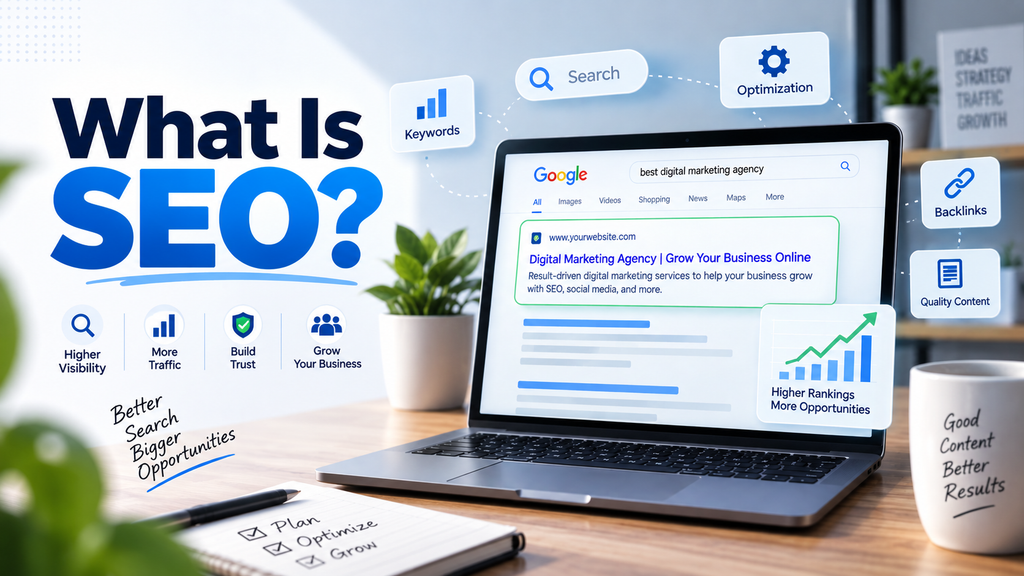
If you’ve ever searched for something on Google and wondered why certain websites appear at the top, the answer is often SEO. But what is SEO, and how does it actually help a business get found online?
SEO stands for Search Engine Optimization. It is the process of improving a website so search engines can understand its content and users can easily find relevant information, products, or services through organic search results.
For businesses, SEO can help increase online visibility, attract relevant visitors, build credibility, and create opportunities for long-term growth without relying entirely on paid advertising.
In this guide, we’ll explain what is SEO, how it works, the main types of SEO, the role of keywords and search intent, common mistakes, and simple steps beginners can take to get started.
What Is SEO?
SEO (Search Engine Optimization) is the process of optimizing a website and its content to improve its visibility in search engine results for relevant searches.
In simple terms, SEO helps search engines understand:
- What your website is about
- Which topics your pages cover
- How useful your content is to visitors
- Which searches your pages may be relevant for
For example, imagine someone searches for “affordable web development services in Hyderabad.” If your website offers web development services and has a well-optimized page that clearly explains those services, SEO can help that page become more visible for relevant searches.
SEO is not about tricking Google or repeating the same keyword again and again. Effective SEO focuses on creating useful content, improving website experience, making information easy to understand, and building trust over time.
How Does SEO Work?
To understand what is SEO, it helps to understand how search engines process websites.
Search engines generally work through three important stages:
1. Crawling
Search engine crawlers discover webpages by following links and visiting websites. They look for new pages, updated content, and other information that can be processed.
2. Indexing
After discovering a page, the search engine analyzes and organizes its content. If the page is eligible for indexing, it can be stored in the search engine’s index.
3. Ranking
When someone performs a search, the search engine determines which indexed pages are most relevant and useful for that particular query and displays them in an order designed to help the user.
SEO helps businesses improve different parts of their website so search engines can discover, understand, and evaluate their pages more effectively.
Why Is SEO Important?
SEO is important because search engines are one of the ways people discover businesses, products, services, and information online.
A website can look excellent, but if potential customers cannot find it when they search for relevant topics, it may receive very little organic traffic.
Here are some key reasons businesses invest in SEO:
- Increase online visibility: Help your pages appear for relevant searches.
- Attract relevant traffic: Reach people who are already searching for related information or services.
- Build credibility: Helpful and well-structured content can strengthen your online presence.
- Support long-term growth: SEO can continue generating organic visibility after content is published.
- Reduce dependence on paid advertising: Organic search can complement paid campaigns and provide another source of website traffic.
- Help local businesses get discovered: Local SEO can improve visibility for location-based searches.
SEO does require time, consistent effort, and ongoing improvement. It is not an overnight marketing strategy.
How Do Search Engines Understand Websites?
Search engines use many signals to understand webpages and determine which results may be useful for a search query.
Some important areas include:
Content Relevance
Your content should clearly address the topic or question behind the user’s search.
Keywords
Keywords are words and phrases people use when searching. Using relevant keywords naturally helps communicate the subject of a page.
Website Structure
Clear headings, logical navigation, internal links, and an organized structure make it easier for both users and search engines to understand your website.
User Experience
Mobile usability, page performance, accessibility, and overall website experience can affect how people interact with your site.
Website Authority
Links and references from relevant, trustworthy websites can contribute to a site’s authority and credibility.
This is why SEO involves much more than simply adding keywords to an article.
What Are the Main Types of SEO?
SEO can be divided into several major areas. Each one focuses on a different part of improving a website’s search visibility.
1. On-Page SEO
On-page SEO focuses on elements that you can optimize directly on your website.
This includes:
- Page titles
- Meta descriptions
- Headings
- Content quality
- Keyword usage
- Image alt text
- Internal links
- URLs
- Content structure
For example, a web development company could create a dedicated service page with a clear title, useful information, relevant keywords, descriptive headings, and links to related pages.
2. Off-Page SEO
Off-page SEO focuses on activities outside your website that can help build authority and credibility.
Common examples include:
- Relevant backlinks
- Digital PR
- Brand mentions
- Business listings
- Online reviews
- Industry relationships
The goal is not to collect as many links as possible. Quality and relevance matter more than simply increasing the number of backlinks.
3. Technical SEO
Technical SEO focuses on the technical foundation of a website.
It can include:
- Website speed and performance
- Mobile-friendliness
- HTTPS
- XML sitemaps
- Robots.txt
- Crawlability
- Site architecture
- Canonical URLs
- Indexing issues
A technically healthy website gives search engines a better foundation for discovering and processing its content.
4. Local SEO
Local SEO helps businesses improve their visibility for searches connected to a specific location.
For example:
“SEO agency near me”
“dentist in Hyderabad”
“best café near Charminar”
Local SEO can involve optimizing your Google Business Profile, maintaining accurate business information, collecting genuine reviews, creating location-relevant content, and building local authority.
What Are Keywords in SEO?
Keywords are the words and phrases people enter into search engines.
For example:
- “digital marketing”
- “what is SEO”
- “SEO services in Hyderabad”
- “best SEO agency for small businesses”
Keyword research helps you understand what your target audience is searching for and what kind of content they expect to find.
Short-Tail Keywords
Short-tail keywords are broad phrases, such as:
“SEO”
They can have high search demand but may also be highly competitive and less specific.
Long-Tail Keywords
Long-tail keywords are more specific phrases, such as:
“SEO services for small businesses in Hyderabad”
They usually have a clearer purpose behind them and can be useful for targeting specific audiences and search needs.
The goal is not to use a keyword as many times as possible. Instead, use relevant terms naturally while creating content that genuinely answers the user’s query.
What Is Search Intent?
Search intent is the reason behind a person’s search.
Understanding intent is an important part of SEO because two searches containing similar words can have completely different purposes.
The four common types of search intent are:
Informational Intent
The user wants to learn something.
Example:
“What is SEO?”
Navigational Intent
The user is looking for a particular website or page.
Example:
Commercial Intent
The user is researching options before making a decision.
Example:
“Best SEO tools for small business”
Transactional Intent
The user is ready to take an action, such as buying or booking something.
Example:
“Buy office chair online”
If your target keyword is “what is SEO,” the page should primarily educate the reader rather than immediately trying to sell a service.
SEO vs Paid Advertising
SEO and paid advertising can both generate website traffic, but they work differently.
| Feature | SEO | Paid Advertising |
|---|---|---|
| Traffic type | Organic | Paid |
| Cost model | Investment in content, optimization, and resources | Usually pay per click or impression |
| Speed | Usually takes time | Can generate traffic quickly |
| Long-term value | Can continue bringing organic visibility | Traffic generally depends on active campaigns |
| Flexibility | Requires ongoing optimization | Budgets and targeting can be adjusted quickly |
| Best suited for | Long-term visibility and sustainable growth | Quick campaigns, promotions, and testing |
For many businesses, the best approach is not choosing one over the other. SEO can build long-term organic visibility while paid advertising can support immediate campaigns and targeted promotions.
Benefits of SEO for Businesses
A well-planned SEO strategy can support different types of businesses.
Local Businesses
Local SEO can help people discover services when searching for businesses in their area.
E-commerce Businesses
Product and category pages can target searches from people researching or purchasing products online.
Service Businesses
Professionals and agencies can create informative content and service pages that attract potential customers through search.
Bloggers and Publishers
SEO can help useful articles reach people searching for specific topics and questions.
Startups and Small Businesses
A focused SEO strategy can help smaller businesses build visibility around specific topics, services, locations, and customer needs.
The biggest advantage is that SEO can help you reach people when they are actively searching for something relevant to your business.
How to Start SEO as a Beginner
If you’re new to SEO, you don’t need to optimize everything at once. Start with the basics.
Step 1: Understand Your Audience
Identify who you want to reach and what questions, problems, or services they are searching for.
Step 2: Research Keywords
Find relevant search terms related to your products, services, and content topics.
Step 3: Create Helpful Content
Write original content that answers real questions and provides useful information.
Step 4: Optimize Your Pages
Improve your titles, headings, URLs, meta descriptions, images, internal links, and content structure.
Step 5: Improve Your Website
Make sure your website is mobile-friendly, easy to navigate, secure, and technically accessible to search engines.
Step 6: Build Authority
Earn relevant backlinks, mentions, reviews, and other signals that strengthen your website’s credibility.
Step 7: Measure Your Results
Use tools such as Google Search Console and analytics platforms to understand search visibility, traffic, and user behavior.
SEO is an ongoing process. Review your results, identify opportunities, update content, and continue improving your website.
Common SEO Mistakes Beginners Should Avoid
Learning what is SEO is only the beginning. Knowing what not to do is equally important.
Keyword Stuffing
Repeating a keyword unnaturally can make content difficult to read and does not create a better experience for users.
Writing Only for Search Engines
Your primary goal should be helping the reader. Search optimization should support useful content, not replace it.
Ignoring Search Intent
A page may target the right keyword but still perform poorly if it does not satisfy what users actually want.
Ignoring Mobile Experience
Many people access websites from smartphones, so your website should work properly across different screen sizes.
Publishing Duplicate or Low-Value Content
Simply rewriting information that already exists does not necessarily provide value. Focus on adding useful information, examples, experience, or a clearer explanation.
Expecting Immediate Results
SEO usually takes time. Competition, website authority, content quality, technical health, and consistency can all influence how quickly results develop.
SEO Trends to Watch in 2026
Search is continuing to evolve, especially as AI-powered experiences become more common.
AI Search and Answer Experiences
Search engines and AI-powered platforms can provide direct answers to users, meaning businesses need content that is clear, useful, well-structured, and easy to understand.
E-E-A-T and Content Credibility
Experience, Expertise, Authoritativeness, and Trustworthiness remain important concepts when creating content users can rely on.
Original and Helpful Content
Generic content is easier to produce than ever. Businesses can stand out by publishing original insights, practical examples, expert perspectives, and genuinely useful information.
Video Search
Video content continues to play an important role in how people discover information, products, and brands. Businesses can consider optimizing useful videos alongside written content.
More Zero-Click Searches
Some users may get the information they need directly from search results without visiting a website. Clear answers, structured content, FAQs, and strong brand visibility can help businesses remain useful in this changing search environment.
Frequently Asked Questions About SEO
What is SEO in simple words?
SEO is the process of improving a website so search engines can understand it and people can discover its pages through relevant organic searches.
What does SEO stand for?
SEO stands for Search Engine Optimization.
How does SEO work?
Search engines discover webpages through crawling, process and organize their content through indexing, and then determine which pages are relevant for particular searches. SEO helps improve a website across these areas.
Is SEO free?
Organic search traffic does not require paying for every click. However, SEO requires time, effort, content creation, technical work, and sometimes paid tools or professional services.
How long does SEO take to work?
There is no fixed timeline. Results can vary depending on competition, website history, content quality, technical improvements, authority, and the consistency of SEO efforts. Some changes may be noticed relatively quickly, while meaningful growth can take considerably longer.
Is SEO important for small businesses?
Yes. SEO can help small businesses target specific services, topics, and local searches and reach people who are actively looking for what they offer.
Can beginners learn SEO without coding?
Yes. Many SEO tasks, including keyword research, content creation, on-page optimization, internal linking, and basic website improvements, can be learned without advanced coding knowledge. Basic technical knowledge can become useful as you progress.
Conclusion
So, what is SEO? In simple terms, SEO is the process of making your website easier for search engines to understand and easier for the right audience to discover.
From keyword research and helpful content to technical improvements, internal linking, local optimization, and authority building, SEO involves several connected activities. The goal is not to manipulate search rankings but to create a website that genuinely provides value to users.
If you’re starting from scratch, focus on the fundamentals: understand your audience, choose relevant keywords, create useful content, optimize your website, and measure your progress.
SEO is a long-term strategy, but when done consistently, it can become an important source of visibility, traffic, leads, and business growth.
Pingback: How to Choose a Digital Marketing Agency in Hyderabad (2026)
Pingback: SEO vs Google Ads: Which Is Better for Your Business in 2026?
Pingback: What Does a Digital Marketing Agency Do? Complete Business Guide
Pingback: What Is Performance Marketing? Complete Guide for Businesses
Pingback: how to generate quality leads