What Is Performance Marketing? A Complete Guide for Businesses in 2026
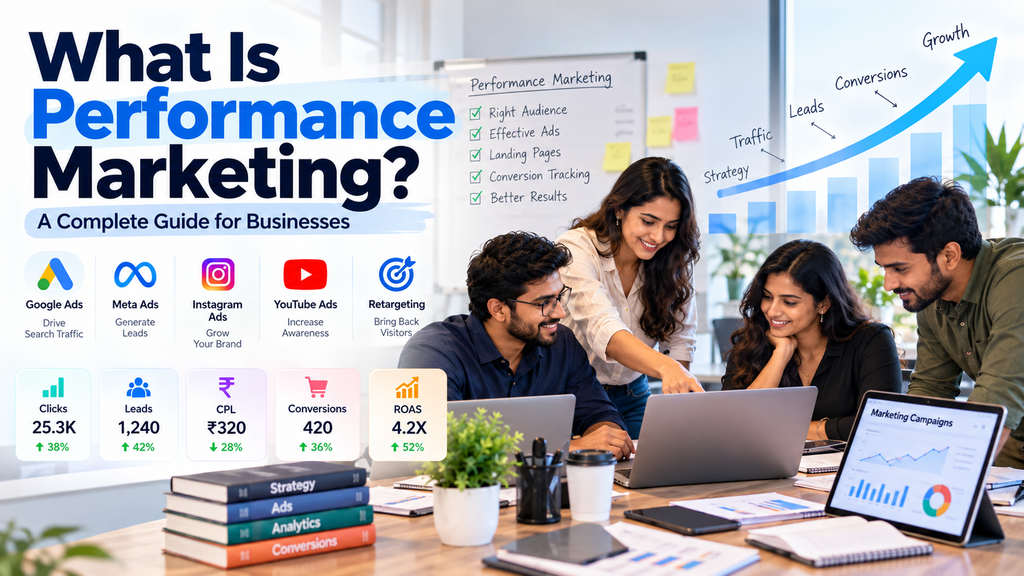
If you are wondering what is performance marketing, it is a results-focused digital marketing approach where businesses measure marketing campaigns based on specific actions such as leads, sales, purchases, bookings, and conversions.
Unlike traditional marketing approaches that may focus mainly on visibility or brand awareness, performance marketing focuses on measurable outcomes. Businesses can use Google Ads, Meta Ads, social media advertising, retargeting, landing pages, and conversion tracking to understand how their marketing campaigns are performing.
In simple terms, performance marketing means planning, running, measuring, and optimizing digital campaigns based on business results.
In this guide, you will learn what performance marketing is, how performance marketing works, its main channels, important KPIs, benefits, common mistakes, and how businesses can use it effectively.
What Is Performance Marketing?
Performance marketing is a digital marketing strategy that focuses on measurable actions and business outcomes.
Instead of measuring a campaign only by impressions, likes, or reach, performance marketers look at actions such as:
- Leads
- Sales
- Purchases
- Bookings
- Phone calls
- Website enquiries
- WhatsApp enquiries
- Form submissions
- App installations
For example, a business may spend ₹20,000 on advertising. Instead of asking only how many people saw the advertisement, the business can measure how many people clicked, generated leads, became customers, and produced revenue.
This makes performance marketing especially useful for businesses that want to make data-driven decisions about their marketing budget.
How Does Performance Marketing Work?
A successful performance marketing strategy usually follows a simple process.
1. Define the Business Goal
The first step is deciding what the campaign should achieve.
A business may want to:
- Generate qualified leads
- Increase online sales
- Get more appointments
- Increase bookings
- Reduce customer acquisition cost
- Improve return on ad spend
- Generate enquiries through WhatsApp
A clear goal helps determine the right campaign, audience, budget, and KPI.
2. Understand the Target Audience
The next step is identifying the people most likely to take the desired action.
Audience research can consider:
- Location
- Age
- Interests
- Search behavior
- Previous website activity
- Customer data
- Purchase intent
For example, a local business may target customers within Hyderabad, while an ecommerce business may target customers across multiple cities.
3. Select the Right Marketing Channel
Performance marketing can use several digital channels, including:
- Google Ads
- Meta Ads
- Instagram Ads
- YouTube Ads
- Display advertising
- Search advertising
- Retargeting
The goal is not to use every platform. The goal is to identify the channels that match the audience and business objective.
4. Launch the Campaign
Campaign execution may involve:
- Ad copy
- Creative design
- Audience targeting
- Keyword targeting
- Landing pages
- Offers
- Budget allocation
- Conversion tracking
5. Track Conversions
Conversion tracking is an important part of performance marketing.
Depending on the business, conversions may include:
Advertisement → Website → Form → Lead → Sales Follow-up → Customer
For ecommerce:
Advertisement → Product Page → Checkout → Purchase → Revenue
Without proper tracking, it becomes difficult to understand which campaigns are actually contributing to business results.
6. Optimize Campaign Performance
Performance marketing does not stop after launching an advertisement.
Marketers analyze campaign data and test:
- Audiences
- Ad creatives
- Headlines
- Offers
- Keywords
- Landing pages
- Calls to action
- Budgets
The best-performing elements can receive more attention, while weak-performing elements can be improved or replaced.
What Are the Main Performance Marketing Channels?
Google Ads
Google Ads is one of the most important channels for capturing users who are actively searching for products or services.
For example, a person searching for “digital marketing agency in Hyderabad” already has a specific requirement.
Google Ads can help businesses appear when potential customers are actively searching.
A performance marketing campaign on Google may include:
- Keyword research
- Search campaigns
- Ad copy
- Bidding
- Budget management
- Search-term analysis
- Landing-page optimization
- Conversion tracking
Google Ads is particularly useful for capturing high-intent search traffic.
Meta Ads
Meta Ads allows businesses to reach potential customers across Facebook and Instagram.
Businesses can use Meta Ads for:
- Lead generation
- Website conversions
- Product sales
- Brand awareness
- Retargeting
- Click-to-message campaigns
A performance marketing agency may test different audiences, creatives, offers, and messages to identify which combinations generate better results.
Creative testing is especially important for paid social campaigns because audience response can vary significantly between different advertisements.
Retargeting
Not every website visitor becomes a customer during their first visit.
Retargeting allows businesses to reconnect with people who have previously interacted with their website, advertisements, or brand.
A simple retargeting journey can look like:
Ad → Website Visit → No Conversion → Retargeting Ad → Website Visit → Conversion
This helps businesses reconnect with users who have already shown interest.
What Are the Important Performance Marketing KPIs?
One of the biggest advantages of performance marketing is measurable reporting.
Click-Through Rate (CTR)
CTR shows how often people click an advertisement after seeing it.
A higher CTR can indicate that the advertisement is relevant to the audience, although CTR alone does not determine campaign success.
Cost Per Click (CPC)
CPC represents the average amount paid for each advertisement click.
Cost Per Lead (CPL)
CPL measures the average cost of generating a lead.
CPL = Total Ad Spend ÷ Number of Leads
For example, if a campaign spends ₹10,000 and generates 50 leads:
CPL = ₹200
Conversion Rate
Conversion rate measures how many visitors complete the desired action.
Conversion Rate = Conversions ÷ Visitors × 100
Customer Acquisition Cost (CAC)
CAC measures how much it costs a business to acquire a customer.
CAC can be more meaningful than CPL because not every lead becomes a customer.
Return on Ad Spend (ROAS)
ROAS measures revenue generated compared with advertising spend.
ROAS = Revenue ÷ Advertising Spend
For example, if ₹10,000 in advertising generates ₹40,000 in attributed revenue:
ROAS = 4X
However, there is no universal “good” KPI for every business. Lead-generation businesses may focus on CPL and qualified leads, while ecommerce businesses may focus heavily on purchases, revenue, and ROAS.
Performance Marketing vs Digital Marketing
Performance marketing is a part of digital marketing.
Digital marketing is a broader category that can include:
- SEO
- Local SEO
- Content marketing
- Social media marketing
- Google Ads
- Meta Ads
- Email marketing
- Website marketing
- Performance marketing
The major difference is the measurement focus.
Digital marketing covers the complete online marketing ecosystem.
Performance marketing focuses strongly on measurable actions and campaign outcomes.
For example, SEO may help a business build long-term organic visibility, while Google Ads can capture high-intent searches and generate measurable conversion data.
Both can work together as part of a complete digital marketing strategy.
What Are the Benefits of Performance Marketing?
A well-planned performance marketing strategy can help businesses:
Measure Marketing Results
Businesses can track leads, conversions, acquisition costs, and revenue instead of relying only on awareness metrics.
Optimize Marketing Budgets
Campaign data can help marketers identify which audiences, advertisements, and channels are performing better.
Improve Lead Generation
Businesses can optimize campaigns toward relevant leads rather than focusing only on total lead volume.
Make Data-Driven Decisions
Instead of guessing what works, marketers can use campaign data to make informed decisions.
Test Different Strategies
Businesses can test different:
- Audiences
- Creatives
- Offers
- Landing pages
- Keywords
- Campaign structures
The research emphasizes that meaningful reporting should connect campaign activity with commercial metrics such as CPL, acquisition cost, ROAS, and conversion rates. Pasted text(20261007-051235)
Performance Marketing for Hyderabad Businesses
Performance marketing can be useful for businesses across Hyderabad, but the strategy should depend on the industry, target audience, and customer journey.
Real Estate
Real estate businesses can use:
- Google Ads
- Meta Ads
- Lead generation campaigns
- Landing pages
- Retargeting
Because property purchases often involve longer decision-making cycles, businesses should focus on lead quality and sales follow-up rather than only lead volume.
Education
Education businesses can combine:
- Google Ads
- Meta Ads
- Lead forms
- Landing pages
- Retargeting
- Webinar campaigns
Healthcare
Healthcare businesses may use:
- Search advertising
- Local SEO
- Google Business Profile
- Educational content
- Conversion-focused landing pages
Ecommerce
Ecommerce businesses can focus on:
- Google Ads
- Meta Ads
- Product campaigns
- Retargeting
- Conversion optimization
- Revenue
- ROAS
Hyderabad businesses can also combine performance marketing with SEO, Local SEO, content, and website optimization rather than treating paid advertising as an isolated activity. Pasted text(20261007-051235)
For businesses that want to combine paid campaigns with broader digital marketing strategies, explore our [digital marketing agency in Hyderabad](/digital-marketing-agency-in-hyderabad/) services.
How to Choose a Performance Marketing Agency
Before hiring a performance marketing agency, ask these questions:
How will you measure campaign success?
The agency should define clear KPIs before launching campaigns.
How will conversions be tracked?
Ask whether the agency can track:
- Forms
- Calls
- WhatsApp enquiries
- Purchases
- Bookings
- Lead forms
How will you improve lead quality?
Generating more leads is not always the objective. The agency should also understand whether those leads are relevant and capable of becoming customers.
Will you receive regular reports?
A useful performance report should explain:
What happened → Why it happened → What should be improved next?
Who owns the advertising accounts?
Your business should retain ownership of important digital assets such as Google Ads, Meta Business Manager, analytics accounts, website, and domain. The agency should generally work through appropriate access. Pasted text(20261007-051235)
Common Performance Marketing Mistakes
Focusing Only on Cheap Leads
A low CPL does not automatically mean a successful campaign.
Ignoring Conversion Tracking
Without reliable conversion tracking, it becomes difficult to understand campaign performance.
Sending Traffic to a Poor Landing Page
Even an effective advertisement can produce weak results if the landing page has unclear messaging, poor UX, or a weak call to action.
Measuring Only Clicks and Impressions
Clicks and impressions are useful, but businesses should also measure conversions, qualified leads, acquisition costs, and revenue.
Changing Campaigns Too Frequently
Performance marketing requires testing and learning. Making frequent changes without enough data can make optimization difficult.
Frequently Asked Questions About Performance Marketing
What is performance marketing?
Performance marketing is a results-focused digital marketing strategy where campaigns are measured using actions such as leads, sales, purchases, bookings, and conversions.
Is performance marketing the same as digital marketing?
No. Performance marketing is one part of the broader digital marketing ecosystem. It focuses more heavily on measurable actions and campaign outcomes.
Which platforms are used for performance marketing?
Common platforms include Google Ads, Meta Ads, Instagram Ads, YouTube Ads, display advertising, and retargeting.
What is a good ROAS in performance marketing?
There is no universal good ROAS. The right target depends on product margins, operating costs, customer lifetime value, and the business model.
Is performance marketing suitable for small businesses?
Yes. Small businesses can use performance marketing when they have a clear objective, appropriate targeting, reliable conversion tracking, and a realistic advertising budget.
What is the difference between performance marketing and SEO?
SEO focuses primarily on improving organic search visibility, while performance marketing often focuses on measurable paid campaign outcomes. Businesses can use both strategies together.
Final Thoughts
So, what is performance marketing?
Performance marketing is a measurable approach to digital marketing that connects:
Business Goal → Target Audience → Campaign → Conversion → Measurement → Optimization
It is not simply about running advertisements.
A strong performance marketing strategy focuses on what happens after someone sees or clicks an advertisement. It measures whether that person becomes a lead, qualified prospect, customer, or source of revenue.
Businesses should therefore look beyond clicks and impressions and focus on qualified leads, conversion rate, CPL, CAC, ROAS, sales, and revenue.
When performance marketing works together with SEO, content marketing, social media, website optimization, and conversion tracking, it becomes part of a complete digital growth strategy.